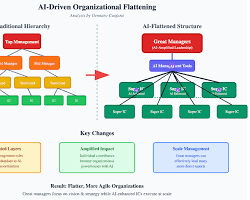
Why organizations are getting flatter
Corporate hierarchies are getting flatter, and AI is a major reason why. Tasks traditionally handled by middle managers, such as reporting, scheduling, coordination, and performance tracking, are increasingly being automated.
As that work gets absorbed into systems and workflows, companies are reducing layers and expecting employees to operate more independently.
What the February 2026 reporting suggests
This article’s source date maps to a February 11, 2026 piece from People Managing People focused on what it called the great flattening of organizations.
That framing fits the broader shift: firms are not removing leadership entirely, but they are questioning how many coordination-focused layers they still need when AI can handle more administrative and operational overhead.
Leadership is changing, not disappearing
This does not eliminate leadership. It redefines it. Instead of supervising people through routine checkpoints, modern professionals are increasingly expected to drive strategy, solve complex problems, align stakeholders, and deliver measurable outcomes.
In other words, value is moving away from oversight and toward impact.
What this means for a resume
For job seekers, this changes how experience should be presented. A resume cannot rely only on phrases like managed team or oversaw operations.
You need to show what changed because of your work: what was improved, accelerated, saved, aligned, or delivered.
Why Aladdin can surface the right signals
Aladdin helps surface those signals by focusing on outcomes and strategic contributions rather than hierarchy-based experience alone.
The future belongs to contributors who can think, not just coordinate.
- Translate management language into business outcomes.
- Show where you solved complexity instead of only overseeing tasks.
- Highlight stakeholder alignment and decision impact.
- Lead with strategic contribution, not just reporting structure.