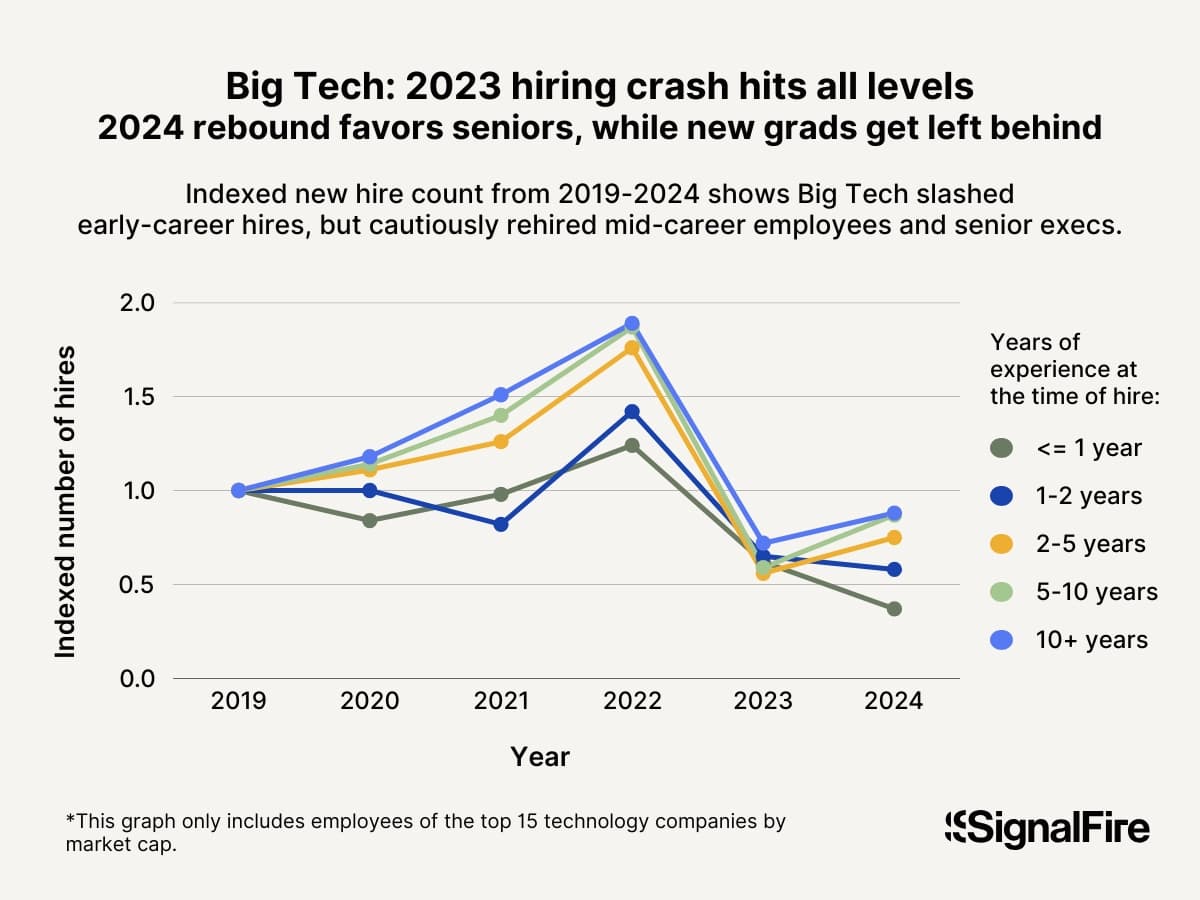
The paradox new graduates are walking into
There is a growing paradox for new graduates: more technology, but fewer entry-level jobs.
That tension is real because AI is absorbing many of the tasks junior roles were traditionally built around, including data entry, basic analysis, documentation, and repetitive workflows.
What the hiring data shows
The chart attached to this post traces back to SignalFire’s State of Tech Talent Report, published on May 20, 2025. That report showed a clear decline in the share of hires made up of workers with one year or less of experience, across both big tech and startups.
The signal is not subtle. Employers are reducing traditional new-grad intake even while continuing to hire more selectively for higher-leverage work.
Why this is a shift, not a disappearance
This does not mean opportunity is disappearing entirely. It means the expectation is changing.
The new entry-level expectation is not pure execution. It is orchestration: working alongside AI tools, validating outputs, managing workflows, and translating results into decisions.
Why proof is beating resumes alone
That creates a fundamentally different early-career skill set. A student or graduate who built a real system, automated a process, or delivered measurable results now stands out more than someone whose evidence is limited to coursework alone.
Employers want to see that you can work with tools, evaluate quality, and turn activity into useful outcomes.
How Aladdin helps early-career candidates compete
Aladdin’s approach to matching supports this shift by prioritizing evidence of ability over titles. That gives new graduates a fairer shot in a market that increasingly rewards demonstrated skill instead of résumé polish.
For junior candidates in 2026, proof is not a bonus anymore. It is the differentiator.
- Show systems, projects, and workflow improvements you have already built.
- Highlight how you validated or improved AI-assisted output.
- Translate coursework into real-world execution wherever possible.
- Use proof of ability to offset a thinner title history.