What the first quarter is actually showing
The first quarter of 2026 tells a clear story: the job market is stable but selective. Hiring is not collapsing, but it is not accelerating broadly either.
Instead, growth is concentrated in a few areas, especially healthcare, smaller employers, and AI-related work, while other parts of the market remain flatter or more cautious.
Why this post is dated March 6, 2026
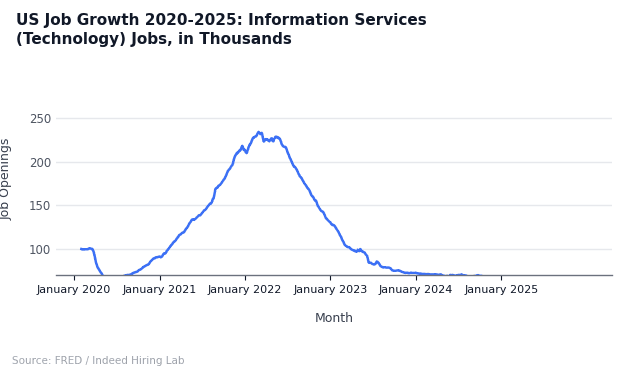
This article is anchored to March 6, 2026, which is the update date on the official FRED and BLS information-sector employment series used here as the chart basis.
That date works as a clean Q1 checkpoint because it sits inside the quarter while reflecting the broader pattern already visible across early-2026 reporting: selective growth, softer large-company hiring, and uneven sector momentum.
Where momentum is concentrating
Healthcare continues to hold up as one of the most resilient hiring engines. Small businesses are also moving more quickly than many larger employers, while AI-related roles continue to attract demand even when broader hiring weakens.
At the same time, transportation and some larger corporate hiring funnels are slowing, and information-sector employment has remained more volatile than many candidates expect.
Why broad searching leads to frustration
This creates a fragmented market where success depends on targeting the right segments. Broad searching often turns into wasted effort because it treats every opening as equally alive and equally worth pursuing.
In a market like this, volume creates exhaustion faster than it creates advantage.
Why smarter matching matters in 2026
Aladdin’s value is in helping users navigate that complexity by identifying where demand actually exists and aligning candidates with those opportunities more precisely.
The core lesson of 2026 is not to apply more. It is to apply smarter.
- Prioritize sectors with real hiring momentum instead of generic volume.
- Treat healthcare, smaller employers, and AI-linked roles as separate opportunity zones.
- Expect a selective market, not a uniformly weak one.
- Use matching quality to narrow effort toward the jobs most likely to move.